

Table of Contents
- Why Custom 3D Printed Plant Pots Are Worth the Investment
- Best Filament for 3D Printed Planters: Material Selection Matters
- 3D Printed Planter Drainage Design: The Critical Element
- How to Seal 3D Printed Planters for Long-Term Use
- Customization Options: Design, Size, and Personalization
- Weight, Stability, and Long-Term Durability for Large Plants
- Ordering Process: Turnaround, Quality Assurance, and Support
- Frequently Asked Questions
Last Updated: September 3, 2026
Why Custom 3D Printed Plant Pots Are Worth the Investment
Custom 3D printed plant pots combine precision engineering with personalization, allowing you to match your décor while solving real horticultural challenges. The right planter directly impacts plant health, root development, and long-term durability.
You can control drainage placement, wall thickness, and material composition to create planters that work for your specific environment rather than forcing plants into generic shapes.
Best Filament for 3D Printed Planters: Material Selection Matters
Filament choice determines durability. Material selection affects drainage integrity, UV resistance, chemical safety, and structural stability.
PLA vs. PETG: Durability and Eco-Friendly Trade-Offs
PLA is plant-based and biodegradable but degrades under UV exposure and softens in warm environments. It works for indoor planters in stable conditions but is a compromise for outdoor use.
PETG resists UV damage, handles temperature fluctuations, and maintains structural integrity over years. Though petroleum-based, PETG is the practical choice for harsh conditions or outdoor exposure.
UV Stability and Thermal Expansion Considerations
Materials expand and contract at different rates with temperature swings. PETG handles these cycles better than PLA, maintaining dimensional stability.
Direct sunlight degrades PLA rapidly within 6-12 months; PETG resists this degradation significantly longer (peer-reviewed research). Specify your intended location when ordering to determine the right material.
3D Printed Planter Drainage Design: The Critical Element
Poor drainage kills plants. Custom 3D printing lets you control exactly where water exits and the drainage system's surface area.
Vase Mode and Drainage Hole Placement for Plant Health
Vase mode printing eliminates internal supports and reduces waste but requires deliberate drainage hole placement. Holes too close together create weak points; too far apart leaves dead zones where water pools.
Cluster multiple smaller drainage holes to distribute water flow evenly and prevent soil washout. Verify holes are at the lowest points and sized for your soil type.
Testing Watertight Integrity Before Purchase
Ask your provider about flood-testing protocols. Legitimate providers verify planters hold water without leaking through walls while draining properly through holes.
Request documentation of test results. If they can't demonstrate testing, reconsider.
How to Seal 3D Printed Planters for Long-Term Use
Unsealed planters absorb water, causing structural degradation and potential soil contamination. Sealing is essential for durability and safety, especially for edible plants.
Post-Processing Techniques for Moisture Resistance
Several sealing methods exist, each with different durability profiles and application complexity.
Epoxy coatings last 5+ years but require surface preparation, ventilation, and 24-48 hours cure time (the FDA). Food-safe formulations are less common and more expensive.
Food-safe polyurethane sealers cure in 4-8 hours, provide good moisture resistance, and are easier to apply than epoxy. Durability ranges from 3-4 years.
Vapor barrier paints are easiest to apply but offer the shortest lifespan (1-2 years). They work best as a first layer under robust sealant.
Have your provider apply food-safe sealant during production for consistent coverage. If sealing yourself, apply 3-4 thin coats rather than one thick coat to avoid bubbling and peeling.
Soil Safety and Chemical Leaching Prevention
PLA leaching risk: PLA degrades in acidic, moist environments, releasing lactic acid and trace oligomers. Risk is highest in outdoor planters and warm climates with acidic-loving plants.
PETG leaching risk: PETG is more stable than PLA but can leach trace acetaldehyde under prolonged moisture and heat, especially in sealed, waterlogged conditions.
Ask your provider whether they test for chemical leaching. Third-party testing or migration testing provides assurance since the FDA doesn't regulate 3D printed food contact articles.
When ordering custom 3D printed plant pots, specify:
- Intended use: edible plants, ornamental plants, or both
- Soil type and pH: acidic, neutral, or alkaline
- Sealing requirement: request food-safe, non-toxic sealant applied during production
- Material preference: PETG for edible applications, PLA acceptable for ornamental plants in neutral soils
- Verification: ask for documentation of sealing quality and, if available, migration testing results
This single specification prevents potential contamination and gives you complete confidence in long-term plant health and safety.
Customization Options: Design, Size, and Personalization
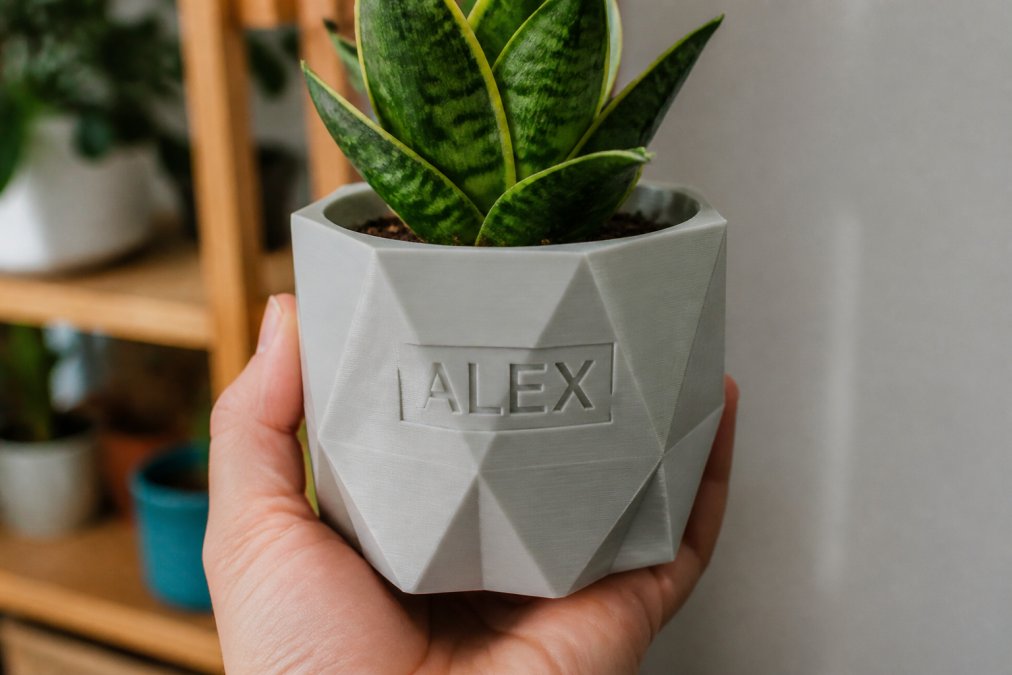
Custom 3D printed plant pots shine in personalization. You control dimensions, aesthetic details, and functional features in ways mass production simply cannot match.
STL Files and Working with Design Services
STL files are digital blueprints for 3D printing. Most buyers benefit from design consultation services that convert your vision into a printable file.
Provide dimensions, reference photos, and preferences. Designers create a mockup for your review and adjustments before production begins.
Geometric Designs and Aesthetic Styles
Geometric patterns, minimalist aesthetics, and organic shapes add visual interest without compromising function. Personalized text, monograms, or symbols can be incorporated directly.
Style options range from modern geometric to bohemian organic to industrial minimalist, matching your home's design language precisely.
Weight, Stability, and Long-Term Durability for Large Plants
Large plants demand stable, durable planters capable of handling structural stress. A pot supporting a 20-pound plant must resist deformation and maintain stability through seasonal cycles.
Load Capacity and Wall Thickness Engineering
Wall thickness directly determines load capacity. Doubling wall thickness increases load capacity roughly 4-8 times.
Thin walls (2-3mm): Suitable for plants under 2 pounds. Minimize cost but offer no safety margin for large plants.
Medium walls (3.5-4.5mm): Practical for houseplants up to 8-10 pounds, balancing efficiency with rigidity.
Thick walls (5-7mm): Required for specimens exceeding 15 pounds or outdoor planters. Weight becomes significant at this thickness.
Provide your provider with mature plant weight when fully hydrated. This specification determines whether your planter will perform reliably.
Material Performance Under Long-Term Stress
PETG performance: PETG maintains structural rigidity through 5+ years and resists creep better than PLA, preventing gradual sagging under heavy plants.
PLA performance: PLA degrades within 2-3 years indoors and 12-18 months outdoors, showing discoloration, crazing, and reduced rigidity. PLA softens at 60°C, risking deformation on hot windowsills (peer-reviewed research).
For large plants, PETG is superior despite higher cost. A 4mm PETG planter outperforms a 6mm PLA planter in load capacity and durability.
Environmental Stress and Failure Modes
Understanding how 3D printed planters fail helps you design for longevity.
Temperature swings cause expansion and contraction stress at layer boundaries. Rounded corners and gradual wall transitions resist this stress better than sharp angles.
Water absorption into unsealed PLA causes swelling and internal stress. Repeated wet-dry cycles create cracks after 12-24 months. Sealing eliminates this.
PLA exhibits creep (permanent deformation) under constant load, showing 2-5mm sag after 18-24 months. PETG resists creep significantly better.
Unprotected PLA degrades within 6-12 months in direct sunlight. PETG resists UV damage better; for outdoor use, PETG is mandatory and UV-protective sealant is recommended.
Design Specifications for Large-Plant Reliability
When ordering, specify:
- Mature plant weight when fully hydrated
- Intended location (indoor/outdoor, sun exposure)
- Material: PETG for planters over 10 pounds or outdoor use
- Wall thickness: Minimum 4.5mm for 8-10 inch planters over 10 pounds
- Sealing: UV-protective sealant for outdoor planters
These specifications transform your custom 3D printed plant pots from decorative objects into engineered containers capable of supporting large plants reliably for years.
Ordering Process: Turnaround, Quality Assurance, and Support
Typical timeline is 2-4 weeks from approved design to delivery. Quality assurance includes visual inspection, dimensional verification, and flood testing. Planters that don't meet specifications are remade at no charge.
Test provider responsiveness before ordering. Legitimate providers respond within 24-48 hours and troubleshoot transparently.
Custom 3D printed plant pots require understanding material properties, drainage engineering, and design specifications. The investment pays dividends through planters that support plant health while matching your aesthetic. Start by describing your needs to the design team.
Frequently Asked Questions
Do 3D printed plant pots need drainage holes to keep plants healthy?
Yes, drainage holes are essential for plant health. Custom 3D printed planters can be designed with precise drainage holes using vase mode printing. Proper drainage prevents root rot by allowing excess water to escape. When ordering custom 3D printed plant pots, verify that the design includes functional drainage holes positioned at the bottom, not just decorative perforations. Testing the planter with water before planting confirms the drainage system works correctly.
What's the best filament for 3D printed planters that will last outdoors?
PETG offers superior UV stability and thermal expansion resistance compared to PLA, making it better for outdoor planters. PLA is more eco-friendly and suitable for indoor use, but degrades faster in sunlight. For planters that will hold moisture and soil, PETG's moisture resistance is crucial. Consider your environment when selecting filament: indoor gardening favors eco-friendly PLA, while outdoor or long-term durability applications benefit from PETG's proven longevity.
How do I seal a 3D printed planter to prevent water leakage and soil damage?
Post-processing is key to sealing 3D printed planters. Options include applying food-safe epoxy resin, using polyurethane coatings, or applying specialized sealants designed for additive manufacturing. The sealing process prevents moisture from seeping through the porous layer structure and protects against chemical leaching from soil into the plastic. Before sealing, smooth the surface using fine-grit sanding and ensure all support structure marks are removed. Apply sealant in thin, even coats to maintain the planter's aesthetic while ensuring long-term durability.
Can I just send a photo or description to get a custom 3D printed planter, or do I need CAD files?
Most custom 3D printing services, including FLM, can work with photos and descriptions, you don't need CAD expertise. Designers can translate your ideas into STL files using your reference images and specifications. The process typically involves an initial consultation to clarify dimensions, drainage needs, infill density, and aesthetic preferences. This collaborative approach means you describe what you want, and professionals handle the technical design work, making custom orders accessible to non-technical users.
This article was written using GrandRanker
0 comments